
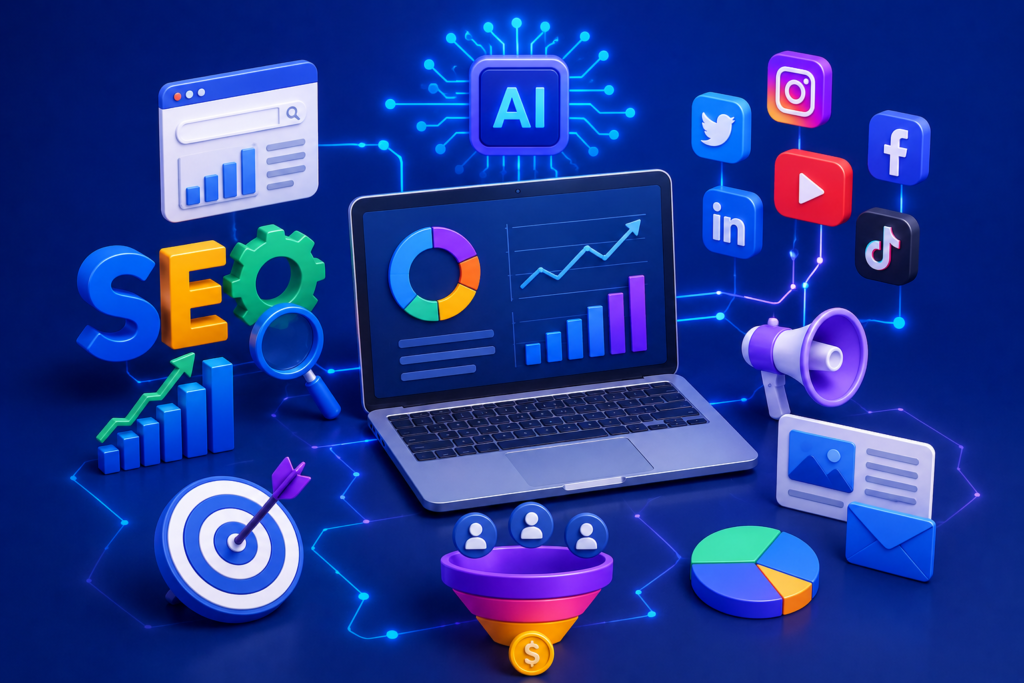
Discover advanced digital marketing strategies for 2026, including SEO, content marketing, AI automation, social media growth, conversion optimization, email marketing, analytics, and brand authority techniques designed to improve online visibility and long-term business growth.
Introduction
Digital marketing has evolved into one of the most powerful business growth systems in the modern economy. Companies that invest in strategic online visibility, audience engagement, and data-driven optimization consistently outperform competitors that rely on outdated promotional methods. In 2026, successful businesses are no longer focused only on traffic generation. They prioritize customer experience, authority building, search visibility, personalization, and sustainable digital growth.
Businesses of every size now compete in highly competitive online environments where search engines, social platforms, and consumer expectations continue to evolve rapidly. Brands that understand how to combine content strategy, search optimization, social engagement, conversion optimization, and automation are positioned for long-term success. Modern consumers expect fast-loading websites, trustworthy information, engaging experiences, and personalized interactions before making purchasing decisions.
At My Blog Poster, businesses can access professional digital marketing strategies designed to improve online authority, increase engagement, and create scalable growth opportunities. This comprehensive guide explores advanced digital marketing methods, practical implementation strategies, and modern best practices aligned with Google’s E-E-A-T standards to help businesses strengthen visibility, improve conversions, and maintain long-term competitive advantages.
Understanding the Modern Digital Marketing Landscape
Digital marketing in 2026 is significantly more advanced than traditional advertising models that focused mainly on impressions and clicks. Today’s successful marketing ecosystem integrates artificial intelligence, search intent optimization, audience segmentation, automation, and behavioral analytics into one cohesive growth strategy. Businesses that fail to adapt to these evolving standards often struggle to compete against brands that prioritize customer-centric experiences.
One of the biggest changes in modern marketing is the shift toward intent-based engagement. Search engines now reward websites that demonstrate genuine expertise, provide helpful information, and satisfy user expectations. Google’s helpful content system emphasizes user-first experiences rather than manipulative SEO tactics. This means businesses must create valuable, accurate, and authoritative content instead of relying on outdated ranking tricks.
Modern digital marketing also includes omnichannel communication strategies. Consumers interact with brands through search engines, social media platforms, email campaigns, video content, podcasts, mobile applications, and community groups. Businesses that create consistent messaging across multiple digital channels improve trust, recognition, and conversion opportunities. A successful strategy focuses not only on attracting traffic but also on nurturing long-term customer relationships.
The Importance of Search Engine Optimization in Digital Marketing
Search engine optimization remains one of the most valuable long-term marketing investments because it helps businesses attract highly targeted organic traffic. Unlike paid advertising, SEO creates sustainable visibility that continues generating results over time. Businesses that rank well for competitive search terms often experience improved credibility, higher engagement, and increased customer trust.
A strong SEO strategy begins with understanding search intent. Modern search engines analyze user behavior, contextual meaning, and content relevance to determine rankings. Businesses must optimize content for informational, navigational, commercial, and transactional search queries. Google’s SEO Starter Guide provides valuable recommendations for improving technical optimization, content structure, and search visibility.
Technical SEO is equally important for long-term performance. Website speed, mobile responsiveness, structured data, secure HTTPS protocols, crawlability, and Core Web Vitals all influence search rankings and user experience. Businesses that invest in technical optimization improve both visibility and customer satisfaction. Combining high-quality content with strong technical foundations creates a scalable SEO strategy capable of supporting long-term digital growth.
Building Authority Through Content Marketing
Content marketing remains one of the most effective ways to establish expertise and build trust with online audiences. High-quality educational content helps businesses answer customer questions, improve search visibility, and position themselves as authoritative industry resources. Modern consumers are more likely to trust businesses that consistently provide helpful and informative content.
Successful content marketing strategies focus on audience needs rather than direct sales messaging. Businesses should create in-depth blog posts, guides, tutorials, case studies, videos, and industry insights that solve real-world problems. Google emphasizes experience and expertise in content evaluation, making original insights and practical recommendations increasingly important for search rankings.
Long-form content often performs exceptionally well because it allows businesses to cover topics comprehensively while naturally integrating relevant keywords and contextual information. Strategic internal linking improves user navigation and distributes authority across important pages. Businesses that maintain consistent publishing schedules and update outdated content regularly often achieve stronger long-term visibility and engagement.
Keyword Research and Search Intent Optimization
Keyword research has evolved far beyond identifying high-volume search phrases. In 2026, businesses must understand user intent, semantic relationships, conversational queries, and contextual relevance. Modern SEO focuses on delivering accurate information that aligns with the expectations behind search behavior.
Primary keywords should be supported by secondary and LSI keywords to create topical depth. Instead of repeatedly targeting one phrase, businesses should build content ecosystems that answer related questions and address broader audience concerns. Tools like Google Trends and Google Search Console help identify emerging opportunities and performance insights.
Intent optimization improves engagement metrics because users find content that matches their expectations. Informational searches require educational content, while transactional searches benefit from persuasive landing pages and conversion-focused messaging. Businesses that align content with intent often achieve lower bounce rates, longer session durations, and improved conversion performance.
The Role of Artificial Intelligence in Digital Marketing
Artificial intelligence has transformed digital marketing workflows by improving personalization, automation, analytics, and customer experiences. AI-powered tools help businesses analyze consumer behavior, optimize campaigns, generate insights, and streamline repetitive tasks. However, successful businesses use AI strategically while maintaining authentic human expertise.
AI-driven personalization enables businesses to deliver targeted recommendations based on browsing history, engagement patterns, and purchasing behavior. Personalized experiences improve customer satisfaction because users receive relevant content, offers, and product suggestions. Businesses that implement intelligent segmentation strategies often achieve higher engagement and conversion rates.
Despite the advantages of automation, human oversight remains essential. Google prioritizes helpful, trustworthy, and accurate content regardless of whether AI tools assist with production. Businesses should focus on originality, fact-checking, and expert insights rather than mass-producing generic content. Combining AI efficiency with human expertise creates scalable marketing systems without compromising quality.
Social Media Marketing and Audience Engagement
Social media marketing continues to play a major role in digital brand visibility and audience engagement. Platforms such as Instagram, LinkedIn, Facebook, TikTok, and YouTube provide businesses with opportunities to build communities, share educational content, and strengthen customer relationships. Effective social media strategies focus on consistency, authenticity, and audience value.
Engagement metrics such as comments, shares, saves, and direct interactions are increasingly important because they reflect genuine audience interest. Businesses that prioritize meaningful conversations often develop stronger brand loyalty and community trust. Educational posts, behind-the-scenes content, industry insights, and interactive campaigns perform particularly well across modern social platforms.
Video content remains one of the most effective engagement formats. Short-form videos improve reach and discoverability, while long-form educational content helps establish expertise. Businesses should also optimize social content for mobile users since a significant percentage of online engagement now occurs on smartphones and tablets.
Conversion Rate Optimization for Sustainable Growth
Generating traffic alone is not enough to achieve meaningful business growth. Conversion rate optimization focuses on improving the percentage of visitors who complete desired actions such as purchases, sign-ups, downloads, or inquiries. Businesses that optimize conversions often achieve better results without increasing advertising costs.
High-converting websites prioritize clarity, simplicity, trust, and user experience. Clear calls-to-action, streamlined navigation, persuasive copywriting, and fast-loading pages significantly influence user behavior. Businesses should continuously test headlines, button placements, landing page structures, and form designs to identify performance improvements.
Trust signals are particularly important in modern digital marketing. Customer reviews, testimonials, secure payment systems, transparent policies, and authoritative content improve credibility and reduce hesitation during purchasing decisions. Businesses that prioritize user trust often experience stronger long-term customer retention and repeat conversions.
Mobile Optimization and User Experience Design
Mobile optimization is no longer optional because mobile devices dominate online browsing behavior. Businesses that fail to deliver fast, responsive, and user-friendly mobile experiences risk losing significant amounts of traffic and engagement. Google’s Core Web Vitals framework highlights the importance of loading speed, interactivity, and visual stability.
Responsive design ensures websites function properly across different screen sizes and devices. Mobile-friendly layouts improve readability, navigation, and usability while reducing frustration for users. Businesses should avoid intrusive popups, oversized media files, and complicated navigation systems that negatively impact mobile experiences.
User experience design also influences search rankings and conversions. Intuitive website structures, accessible interfaces, and logical content organization improve customer satisfaction and engagement. Businesses that prioritize usability often achieve stronger SEO performance because search engines reward websites that deliver positive user experiences.
Email Marketing and Customer Retention Strategies
Email marketing remains one of the highest-performing digital marketing channels because it enables direct communication with highly targeted audiences. Businesses can use email campaigns to nurture leads, promote products, educate subscribers, and maintain long-term customer relationships. Personalized email sequences often generate significantly higher engagement compared to generic mass messaging.
Effective email marketing begins with audience segmentation. Businesses should categorize subscribers based on interests, purchasing behavior, demographics, and engagement history. Segmented campaigns deliver more relevant messaging, improving open rates and conversions. Automated workflows also help businesses send timely communications such as welcome emails, abandoned cart reminders, and follow-up sequences.
Delivering value consistently is essential for long-term subscriber retention. Educational newsletters, industry updates, exclusive offers, and practical insights help maintain engagement while strengthening brand trust. Businesses should also prioritize email deliverability by following Google email sender guidelines and maintaining clean subscriber lists.
Paid Advertising and Performance Marketing
Paid advertising continues to provide businesses with scalable opportunities for rapid traffic generation and lead acquisition. Platforms such as Google Ads, Facebook Ads, LinkedIn Ads, and YouTube Ads allow businesses to target highly specific audiences based on demographics, interests, search intent, and behavioral data.
Successful performance marketing strategies rely heavily on audience research and campaign optimization. Businesses should continuously monitor click-through rates, conversion metrics, cost-per-acquisition, and return on ad spend to maximize profitability. Data-driven decision-making enables marketers to identify high-performing campaigns while eliminating ineffective strategies.
Landing page optimization plays a critical role in advertising success. Even well-targeted campaigns can underperform if users encounter confusing layouts, slow loading speeds, or weak messaging after clicking an advertisement. Businesses that align ad messaging with optimized landing pages typically achieve stronger engagement and improved conversion rates.
Local SEO and Geographic Search Visibility
Local SEO is essential for businesses that serve specific geographic regions or physical communities. Consumers increasingly use location-based searches to find nearby services, products, and solutions. Businesses that optimize for local visibility improve discoverability and attract highly relevant traffic.
Creating and maintaining an optimized Google Business Profile is one of the most important local SEO strategies. Accurate business information, positive reviews, updated contact details, and regular activity improve local search visibility. Businesses should also ensure consistency across directories and citation platforms.
Localized content strategies further strengthen regional visibility. Businesses can create location-specific landing pages, blog posts, and case studies that address local audience needs and search behavior. Incorporating geographic keywords naturally within content helps search engines understand regional relevance while improving user engagement.
Video Marketing and Visual Content Strategies
Video marketing has become one of the most influential digital communication methods because audiences consume visual content more frequently than ever before. Educational videos, tutorials, webinars, interviews, and product demonstrations help businesses engage users while simplifying complex information.
Short-form video content performs exceptionally well on social media platforms because it captures attention quickly and encourages interaction. Businesses can use concise videos to promote products, answer common questions, and increase brand awareness. Meanwhile, long-form video content supports authority building and audience education.
Search optimization for video content is equally important. Businesses should optimize titles, descriptions, thumbnails, captions, and metadata to improve discoverability across platforms like YouTube and Google search results. Adding transcripts and structured data also improves accessibility and search engine understanding.
Analytics, Data Tracking, and Marketing Measurement
Data analytics is one of the most important foundations of modern digital marketing because it enables businesses to measure performance accurately and make informed decisions. Without reliable data, marketers cannot identify strengths, weaknesses, or growth opportunities.
Businesses should monitor key performance indicators such as traffic sources, bounce rates, conversion rates, customer acquisition costs, and engagement metrics. Platforms like Google Analytics provide valuable insights into user behavior and campaign performance. Data-driven strategies allow businesses to optimize marketing efforts continuously.
Behavioral analytics also help businesses understand customer journeys and identify friction points within websites or sales funnels. Heatmaps, session recordings, and user flow reports reveal areas where visitors lose interest or abandon conversions. Businesses that analyze user behavior effectively often improve engagement and revenue performance.
Common Digital Marketing Mistakes Businesses Must Avoid
Many businesses struggle with digital marketing because they focus on short-term tactics instead of sustainable strategies. One of the most common mistakes is prioritizing quantity over quality. Publishing low-value content or relying on keyword stuffing often damages credibility and search performance.
Another major mistake involves ignoring technical optimization. Slow-loading websites, poor mobile usability, broken links, and weak security protocols negatively impact both user experience and search visibility. Businesses should regularly audit their websites to identify technical issues before they affect performance.
Inconsistent branding also creates confusion and weakens trust. Businesses that communicate different messages across platforms often struggle to establish authority and recognition. Maintaining consistent visual identity, tone, and messaging strengthens audience trust while improving overall marketing effectiveness.
Best Practices for Long-Term Digital Marketing Success

Long-term digital marketing success depends on consistency, adaptability, and customer-focused strategies. Businesses should prioritize delivering genuine value instead of chasing short-term trends or manipulative tactics. Search engines increasingly reward websites that demonstrate expertise, trustworthiness, and helpful user experiences.
Continuous learning is essential because digital marketing evolves rapidly. Businesses should stay informed about algorithm updates, consumer behavior trends, and emerging technologies. Following trusted resources such as Google Search Central helps marketers maintain effective and compliant strategies.
Sustainable growth also requires strategic diversification. Businesses that rely exclusively on one traffic source or platform risk significant instability. Combining SEO, content marketing, social engagement, email campaigns, and paid advertising creates a balanced marketing ecosystem capable of supporting long-term growth and resilience.
FAQs
1. What is digital marketing?
Digital marketing refers to the use of online platforms, technologies, and strategies to promote businesses, products, and services. It includes SEO, content marketing, social media marketing, email campaigns, paid advertising, and analytics.
2. Why is SEO important in digital marketing?
SEO helps businesses improve organic visibility in search engines, attract targeted traffic, and build long-term credibility. Strong SEO strategies also improve user experience and website authority.
3. How does content marketing help businesses grow?
Content marketing builds trust, educates audiences, improves search visibility, and supports customer engagement. High-quality content positions businesses as authoritative resources within their industries.
4. What role does AI play in digital marketing?
AI helps automate tasks, analyze customer behavior, personalize experiences, and improve marketing efficiency. However, human expertise remains essential for maintaining quality and authenticity.
5. How often should businesses publish content?
Consistency is more important than frequency. Businesses should maintain realistic publishing schedules while prioritizing quality, originality, and audience value.
6. What are Core Web Vitals?
Core Web Vitals are performance metrics that measure loading speed, interactivity, and visual stability. These metrics influence user experience and search engine rankings.
7. Is social media marketing necessary for every business?
Most businesses benefit from social media because it improves brand visibility, audience engagement, and customer communication. The best platforms depend on the target audience and business goals.
8. How can businesses measure digital marketing success?
Businesses can measure success using analytics tools that track traffic, conversions, engagement, lead generation, customer acquisition costs, and revenue growth.
Best Practices Summary
- Focus on user-first content strategies
- Prioritize mobile optimization and website speed
- Build topical authority with comprehensive content
- Use ethical SEO practices aligned with Google guidelines
- Diversify traffic sources for long-term stability
- Monitor analytics and optimize campaigns continuously
- Maintain consistent branding across all platforms
- Invest in audience engagement and community building
- Update outdated content regularly
- Combine automation with human expertise
Conclusion
Digital marketing in 2026 requires far more than basic online promotion. Businesses must build authority, deliver valuable experiences, optimize for search intent, and maintain strong relationships with audiences across multiple digital channels. Companies that prioritize quality, transparency, user experience, and data-driven optimization are far more likely to achieve sustainable growth and long-term competitive advantages.
Businesses that embrace modern digital marketing strategies can improve visibility, increase conversions, strengthen customer trust, and create scalable growth systems capable of adapting to future technological changes. By combining SEO, content marketing, analytics, automation, social engagement, and conversion optimization, brands can position themselves for consistent success in increasingly competitive online environments.
At My Blog Poster, businesses can access professional marketing solutions designed to improve digital visibility, strengthen authority, and support sustainable business growth through modern, ethical, and results-focused strategies.
Want to Implement This Easily?
Prompt Text
You are an expert consultant. Based on the blog post titled “Digital Marketing”, provide a step-by-step, practical implementation guide. Include tools, best practices, common mistakes to avoid, and advanced tips. Assume the reader wants to implement everything discussed in this article effectively.
Call to Action
Want our help implementing this? Just reach out to us via our website contact form: https://www.myblogposter.com/contact-us/