
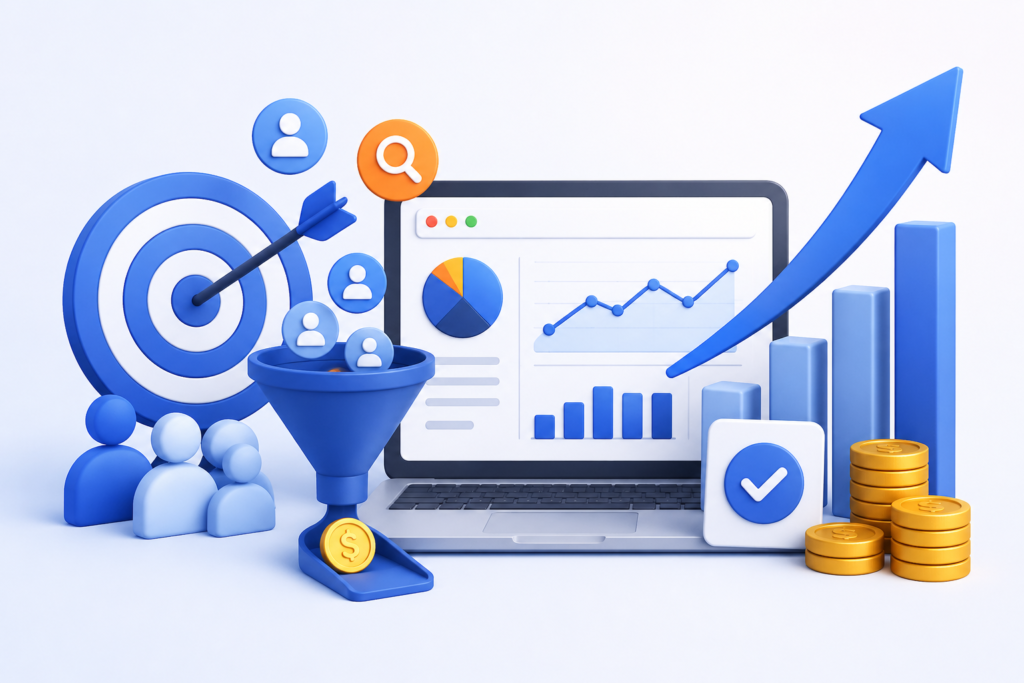
Learn how Facebook Ads can help businesses increase brand visibility, generate qualified leads, improve conversions, and maximize advertising ROI through advanced audience targeting, creative optimization, and data-driven campaign strategies.
Introduction
Digital advertising continues to evolve, yet Facebook Ads remains one of the most powerful platforms for businesses seeking measurable growth. With billions of active users across Facebook, Instagram, Messenger, and the Meta Audience Network, advertisers gain access to an enormous ecosystem capable of reaching highly targeted audiences at every stage of the customer journey.
Businesses of all sizes use Facebook advertising to build awareness, generate leads, increase sales, and strengthen customer relationships. Unlike traditional advertising channels that often rely on broad demographics, Facebook Ads provides sophisticated targeting capabilities that enable marketers to reach users based on interests, behaviors, purchasing intent, demographics, and engagement history. This precision helps businesses allocate advertising budgets more efficiently while improving campaign performance.
At My Blog Poster, we understand that successful Facebook advertising requires more than simply launching campaigns. Sustainable results come from strategic planning, audience research, compelling creative assets, continuous optimization, and data-driven decision-making. This guide explores the essential components of effective Facebook advertising and provides practical insights businesses can use to maximize return on investment while building long-term growth.
Understanding the Power of Facebook Ads in Modern Marketing
Facebook Ads has transformed the way businesses communicate with potential customers. Instead of relying solely on organic visibility, brands can now place highly relevant messages directly in front of carefully selected audiences. This capability creates opportunities for businesses to expand reach, improve engagement, and drive measurable business outcomes.
One of the platform’s greatest strengths is its extensive user data. Facebook collects valuable behavioral and demographic information that allows advertisers to create highly specific audience segments. Whether a company wants to target local consumers, international buyers, first-time visitors, or returning customers, Facebook provides tools that support precision marketing strategies.
The advertising ecosystem also offers exceptional flexibility. Organizations can run campaigns focused on awareness, website traffic, lead generation, app installations, video views, engagement, catalog sales, or direct conversions. This versatility enables businesses to align advertising objectives with broader marketing goals while maintaining complete visibility into campaign performance metrics.
Why Facebook Ads Continue to Deliver Strong ROI
Many businesses choose Facebook advertising because of its ability to generate measurable returns. Unlike traditional advertising channels, Facebook provides detailed performance analytics that help marketers understand exactly how campaigns influence business outcomes.
The platform’s advanced targeting features reduce wasted advertising spend by ensuring ads are shown to audiences most likely to engage. Businesses can identify users based on interests, demographics, online behavior, purchasing patterns, and previous interactions. This level of precision significantly improves campaign efficiency.
Another important factor is scalability. Small businesses can begin with modest budgets and gradually increase spending as campaigns prove successful. Large enterprises can simultaneously manage multiple campaigns across various audience segments while maintaining centralized performance tracking and optimization processes.
Building a Strong Facebook Advertising Strategy
A successful Facebook advertising campaign begins with a clearly defined strategy. Businesses must identify specific objectives before creating ads, selecting audiences, or allocating budgets. Without strategic direction, campaigns often suffer from inconsistent performance and inefficient spending.
The most effective advertising strategies align closely with business goals. Companies seeking brand visibility may prioritize reach and awareness campaigns, while e-commerce businesses often focus on conversion-driven objectives. Lead generation campaigns may require different creative approaches than campaigns designed to increase product sales.
Strategic planning should also include competitor analysis, audience research, content development, budget forecasting, and performance measurement frameworks. Establishing these foundations before launching campaigns creates a stronger pathway toward sustainable advertising success.
Audience Targeting: The Foundation of Facebook Advertising Success
Audience targeting is arguably the most important component of Facebook advertising. Even exceptional ad creatives can fail if they reach the wrong audience. Understanding customer demographics, interests, behaviors, and motivations allows businesses to create highly relevant advertising experiences.
Facebook’s targeting capabilities include demographic filters such as age, gender, education level, occupation, relationship status, and geographic location. Advertisers can combine these factors to create detailed audience profiles aligned with ideal customer characteristics.
Behavioral and interest-based targeting adds another layer of sophistication. Businesses can target users who have demonstrated interests related to specific industries, hobbies, products, services, or purchasing behaviors. This precision increases engagement rates while improving conversion opportunities.
Leveraging Custom Audiences and Lookalike Audiences
Custom Audiences allow businesses to reconnect with users who have previously interacted with their brand. These audiences may include website visitors, email subscribers, app users, video viewers, or previous customers. Since these individuals already have some familiarity with the brand, they often demonstrate higher conversion potential.
Retargeting campaigns built around Custom Audiences can significantly improve advertising efficiency. Businesses can deliver personalized messages to users based on previous interactions, encouraging them to return and complete desired actions.
Lookalike Audiences expand reach by identifying new users who share characteristics with existing customers. Facebook analyzes source audience data and finds similar users likely to engage with the brand. This approach helps businesses discover new customer segments while maintaining targeting accuracy.
Creating High-Converting Facebook Ad Creative

Creative quality plays a critical role in campaign success. Effective Facebook ads must capture attention quickly, communicate value clearly, and motivate users to take action. Since users scroll rapidly through social feeds, advertisers have only a few seconds to create meaningful engagement.
Visual elements should be compelling, relevant, and aligned with brand identity. High-quality images, videos, animations, and graphics often outperform generic visuals because they create stronger emotional connections and improve message retention.
Copywriting is equally important. Strong headlines, persuasive descriptions, and clear calls-to-action help guide users toward desired outcomes. Advertisers should focus on customer benefits rather than product features, demonstrating how solutions address specific challenges or opportunities.
The Role of Video Advertising in Facebook Campaigns
Video content has become one of the most effective advertising formats available on Facebook. Videos capture attention more effectively than static images and allow brands to communicate complex messages in engaging ways.
Short-form videos often perform exceptionally well because they accommodate modern consumer behavior. Users can quickly understand key messages without committing significant time. Product demonstrations, tutorials, testimonials, behind-the-scenes content, and educational videos frequently generate strong engagement rates.
Video campaigns also support multiple objectives, including awareness, engagement, lead generation, and conversions. Businesses that incorporate video into their advertising strategies often experience improved audience retention, stronger brand recall, and higher overall campaign performance.
Understanding Facebook Ad Formats and Placements
Facebook offers a wide variety of advertising formats designed to support different marketing goals. Choosing the right format can significantly influence campaign effectiveness and user engagement.
Popular formats include image ads, video ads, carousel ads, slideshow ads, collection ads, instant experience ads, and lead generation ads. Each format provides unique advantages depending on campaign objectives and audience preferences.
Placement selection is equally important. Advertisers can display campaigns across Facebook feeds, Instagram feeds, Stories, Reels, Messenger, and the Meta Audience Network. Strategic placement optimization ensures advertisements appear where target audiences are most likely to engage.
Facebook Pixel and Conversion Tracking
Successful Facebook advertising depends heavily on accurate data collection and performance measurement. Without reliable tracking systems in place, businesses struggle to understand which campaigns generate results and which areas require improvement. This is why conversion tracking remains one of the most critical components of a high-performing Facebook Ads strategy.
The Facebook Pixel, now integrated through Meta’s tracking infrastructure, enables advertisers to monitor user behavior after ad interactions. Businesses can track important actions such as page views, form submissions, purchases, newsletter signups, downloads, and other conversion events. These insights provide valuable information about customer journeys and help marketers identify the touchpoints that contribute most to revenue generation.
Accurate conversion tracking also improves campaign optimization. Facebook’s machine learning algorithms rely on conversion data to identify users who are more likely to complete desired actions. As more data becomes available, campaigns become increasingly efficient, resulting in lower acquisition costs, improved conversion rates, and stronger overall advertising performance.
Budgeting and Bid Strategies for Maximum ROI
Budget management plays a significant role in Facebook advertising success. Many businesses mistakenly assume that larger budgets automatically produce better results. In reality, strategic allocation and continuous optimization often matter more than the total amount spent.
Advertisers can choose between daily budgets and lifetime budgets depending on campaign objectives. Daily budgets provide consistent spending control, while lifetime budgets allow Facebook to optimize delivery across a specified campaign period. Both approaches can be effective when aligned with campaign goals and performance expectations.
Bid strategies further influence campaign outcomes. Automated bidding helps Facebook maximize results within budget constraints, while manual bidding gives advertisers greater control over costs. Businesses should regularly analyze cost-per-click, cost-per-acquisition, return on ad spend, and conversion metrics to ensure budgets are being used effectively and efficiently.
Using Facebook Ads for Lead Generation
Lead generation remains one of the most popular uses of Facebook advertising. Businesses across industries use Facebook to capture contact information from potential customers and move prospects into their sales funnels.
Lead generation campaigns eliminate unnecessary friction by allowing users to submit information directly within the platform. Instead of redirecting users to external landing pages, Facebook Lead Forms streamline the process and improve completion rates. This convenience often results in higher lead volumes and lower acquisition costs.
However, generating leads is only the first step. Businesses must develop effective follow-up systems that nurture prospects through email marketing, sales outreach, content distribution, and personalized engagement. Combining Facebook lead generation with strong customer relationship management processes significantly improves conversion opportunities and long-term business growth.
E-Commerce Growth Through Facebook Advertising
Facebook Ads has become an essential marketing channel for e-commerce businesses seeking scalable growth. The platform provides powerful tools that enable online stores to showcase products, recover abandoned carts, and drive direct purchases.
Dynamic product advertising allows businesses to automatically display relevant products to users based on browsing behavior and purchase intent. These personalized experiences increase relevance and encourage potential customers to revisit products they previously viewed.
Catalog campaigns further enhance e-commerce performance by automating product promotion across large inventories. Combined with retargeting strategies and audience segmentation, e-commerce businesses can create highly personalized shopping experiences that increase conversion rates, average order values, and customer lifetime value.
A/B Testing for Continuous Campaign Improvement
Even experienced marketers cannot accurately predict which advertising elements will perform best without testing. A/B testing provides a structured approach to identifying winning strategies and improving campaign effectiveness over time.
Advertisers can test various components including headlines, ad copy, visuals, calls-to-action, audience segments, placements, landing pages, and bidding strategies. By changing only one variable at a time, marketers gain clear insights into which elements contribute most to performance improvements.
Continuous testing supports data-driven decision-making. Rather than relying on assumptions, businesses can optimize campaigns based on measurable evidence. This process reduces inefficiencies, improves advertising outcomes, and helps organizations remain competitive in increasingly crowded digital marketplaces.
Measuring Facebook Ads Performance Effectively
Campaign success should be evaluated using meaningful performance indicators aligned with business objectives. While vanity metrics such as likes and impressions may provide useful context, they rarely tell the complete story.
Businesses focused on lead generation should prioritize metrics such as cost per lead, lead quality, conversion rates, and customer acquisition costs. E-commerce organizations may place greater emphasis on return on ad spend, average order value, purchase frequency, and revenue attribution.
Regular reporting and performance analysis enable marketers to identify trends, uncover opportunities, and address challenges before they negatively impact results. Consistent measurement creates a foundation for ongoing optimization and sustainable advertising growth.
Integrating Facebook Ads with Broader Digital Marketing Strategies
Facebook advertising produces the strongest results when integrated with a comprehensive digital marketing strategy. Rather than operating as an isolated channel, Facebook Ads should support and enhance other marketing initiatives.
Content marketing, search engine optimization, email marketing, social media engagement, and conversion rate optimization all contribute to overall advertising success. Businesses that align messaging across channels create more consistent customer experiences and improve brand recognition.
Integrated marketing strategies also improve attribution accuracy. Understanding how Facebook Ads interacts with other channels helps businesses allocate resources more effectively while maximizing overall marketing performance.
Adapting to Privacy Changes and Platform Evolution

Digital advertising continues to evolve as privacy regulations, user expectations, and technology standards change. Facebook advertisers must remain informed about industry developments and adjust strategies accordingly.
Privacy-focused updates have increased the importance of first-party data collection, consent management, and transparent data practices. Businesses that prioritize trust and compliance are better positioned to maintain advertising effectiveness while protecting customer relationships.
Adaptability is essential for long-term success. Marketers who continuously learn, test new features, and embrace emerging technologies can maintain competitive advantages while navigating changes in the digital advertising landscape.
Common Facebook Ads Mistakes Businesses Should Avoid
Many businesses experience disappointing results because they repeat common advertising mistakes that limit campaign effectiveness. Identifying and avoiding these errors can significantly improve performance and return on investment.
One frequent mistake is targeting audiences that are either too broad or too narrow. Broad audiences may waste advertising spend on irrelevant users, while overly restrictive targeting can limit campaign reach and increase costs. Successful advertisers balance precision with scalability.
Another common issue involves weak creative assets. Poor-quality visuals, unclear messaging, and ineffective calls-to-action often reduce engagement and conversion rates. Advertisers should invest in high-quality creative development and regularly refresh ad content to prevent audience fatigue.
Businesses also frequently neglect testing and optimization. Launching campaigns without monitoring performance or making improvements can result in missed opportunities and declining effectiveness. Continuous analysis remains essential for sustained success.
Best Practices Summary for Long-Term Facebook Advertising Success
Successful Facebook advertising requires a strategic, data-driven approach focused on continuous improvement. Businesses should begin with clearly defined objectives that align with broader organizational goals and establish measurable success criteria.
Audience research should remain a priority throughout campaign development. Understanding customer needs, motivations, and behaviors allows advertisers to create more relevant and compelling experiences that generate stronger engagement and conversion rates.
Creative excellence, accurate tracking, consistent testing, and ongoing optimization form the foundation of long-term advertising success. Organizations that embrace these best practices position themselves to achieve sustainable growth while maximizing advertising efficiency and profitability.
Frequently Asked Questions
1. Are Facebook Ads still effective in 2026?
Yes. Facebook Ads continues to be one of the most effective digital advertising platforms due to its extensive audience reach, advanced targeting capabilities, sophisticated machine learning systems, and comprehensive performance tracking tools.
2. How much should I spend on Facebook Ads?
Budget requirements vary depending on industry, competition, objectives, and audience size. Many businesses begin with smaller budgets to test campaigns before increasing spending based on proven performance data.
3. How long does it take for Facebook Ads to produce results?
Some campaigns generate results within days, while others require several weeks of testing and optimization. Consistent monitoring and adjustments typically improve outcomes over time.
4. What is the best Facebook Ad format?
The ideal format depends on campaign objectives. Video ads often perform well for engagement and awareness, while carousel ads, collection ads, and dynamic product ads frequently excel for e-commerce campaigns.
5. Can small businesses compete with larger advertisers?
Yes. Facebook’s targeting capabilities allow small businesses to focus on highly relevant audience segments, helping them compete effectively without requiring enterprise-level budgets.
6. Why is audience targeting so important?
Targeting determines who sees advertisements. Reaching the right audience improves engagement, reduces wasted spending, and increases the likelihood of generating conversions.
7. How often should Facebook Ads be optimized?
Campaigns should be reviewed regularly. Weekly analysis is common, while high-budget campaigns may require daily monitoring to maximize performance and respond quickly to changing trends.
8. What metrics matter most for Facebook Ads?
Important metrics include click-through rate, conversion rate, cost per acquisition, cost per lead, return on ad spend, engagement rate, and customer lifetime value depending on campaign objectives.
Conclusion
Facebook Ads remains one of the most powerful tools available for businesses seeking scalable digital growth. Through advanced audience targeting, sophisticated optimization capabilities, and comprehensive analytics, organizations can connect with ideal customers more effectively than ever before.
Success, however, requires more than simply launching advertisements. Businesses must combine strategic planning, audience insights, creative excellence, accurate tracking, testing, and ongoing optimization to achieve sustainable results. Those who adopt a long-term, data-driven approach are better positioned to maximize advertising efficiency and improve return on investment.
At My Blog Poster, we recognize that successful Facebook advertising is built on expertise, consistency, and continuous adaptation. By implementing the strategies outlined in this guide, businesses can strengthen brand visibility, generate higher-quality leads, increase conversions, and create lasting competitive advantages in an increasingly digital marketplace.
Want to Implement This Easily?
Prompt Text:
You are an expert consultant. Based on the blog post titled “Facebook Ads”, provide a step-by-step, practical implementation guide. Include tools, best practices, common mistakes to avoid, and advanced tips. Assume the reader wants to implement everything discussed in this article effectively.
Call to Action:
Want our help implementing this? Just reach out to us via our website contact form: